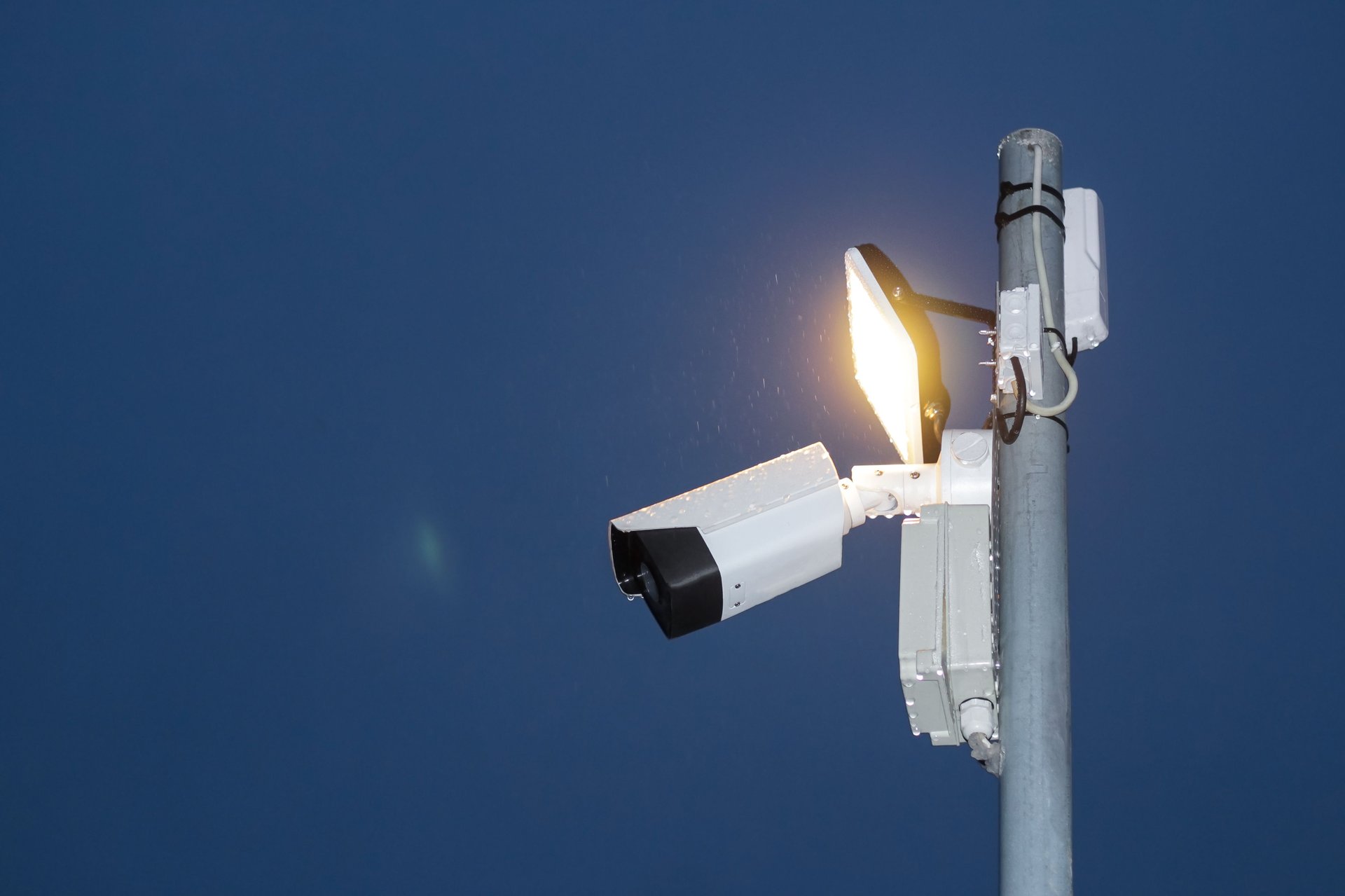
Your IR camera reaches 30-100 m in black and white. Your ColorVu reaches 0.0005 lux — but only with its white LED on. Not the same system: it’s a different decision about what needs to be visible at 3 AM.
Three numbers that matter when comparing night-time illumination tech:
| Technology | Color in the dark? | Typical range | Announces presence? |
|---|---|---|---|
| Standard IR (850 nm LED) | No — always B&W | 30-100 m integrated [3][6] | No (invisible) |
| IR + external illuminator | No — always B&W | 95-300 m (PoE), 1000 m high-voltage [6] | No |
| Starlight / Lightfinder 2.0 (large sensor, F1.0) | Yes — color without extra light | Color down to 0.02-0.05 lux [2] | No |
| ColorVu / Full-color (white LED) | Yes — full color | 0.0005 lux @ F1.0 with white LED [4] | Yes — LED visible |
( per IPVM 2026 + IEC 62676-4:2025 §6.9 + Axis Lightfinder white paper )
It’s not a technical decision, it’s a use-case one:
- Anonymous (parking lot, street, ANPR): IR. Range > color; discreet presence. ColorVu here is a nuisance — the white LED lights up the neighbor’s sidewalk.
- Forensic (clothing color, vehicle color): ColorVu or Lightfinder. Without color, the footage loses evidentiary value [5].
- Deterrence (driveway, storefront): ColorVu = visible deterrent. When a subject knows they’re being filmed in color, they behave differently [1].
- Industrial perimeter: IR + dedicated external illuminator. 300 m of PoE IR covers a long fence line [6].
The detail nobody tells you: Axis Lightfinder 2.0 delivers color at 0.05 lux without a white LED [2]. Hikvision ColorVu delivers color at 0.0005 lux only when the white LED turns on [4]. The first is discreet; the second is a 20-40 m floodlight with a camera inside. “Lower lux” ≠ “better” — always ask whether the lux figure includes the artificial light. ( IEC 62676-4 §2.3 confirms that comparing lux across manufacturers is risky [7] )
The right question is “what happens here at 3 AM?”. If you need to see the color of a suspect’s jacket — ColorVu. If you need to see motion at 80 m without announcing the camera — IR.
P.D. Does your camera record color at night? If not, and you need forensics, check whether the site has enough ambient light for Starlight before buying white light. If you already have integrated IR, test the B&W at real 30 m — not at brochure distance.
📰 Source: IPVM 2026 ColorVu/Lightfinder/IR reports + Hikvision ColorVu + Axis Lightfinder 2.0 white paper + Raytec White-Light analytics study + IEC 62676-4:2025 §6.9. Accessed 2026-09-07.
Sources
[1] https://ipvm.com/reports/colorvu-smart [2] https://www.axis.com/solutions/lightfinder [3] https://cctvinfo.com/compare/cctv-night-vision-comparison [4] https://www.hikvision.com/us-en/products/network-products/network-cameras/colorvu-series/ [5] https://www.raytecled.com/2022/10/18/using-white-light-for-camera-analytics/ [6] https://ipvm.com/reports/comparing-surveillance-ir-illuminators [7] https://webstore.iec.ch/en/publication/83425 [8] https://netviewcctv.co.uk/blog/post/hikvision-colorvu-complete-guide