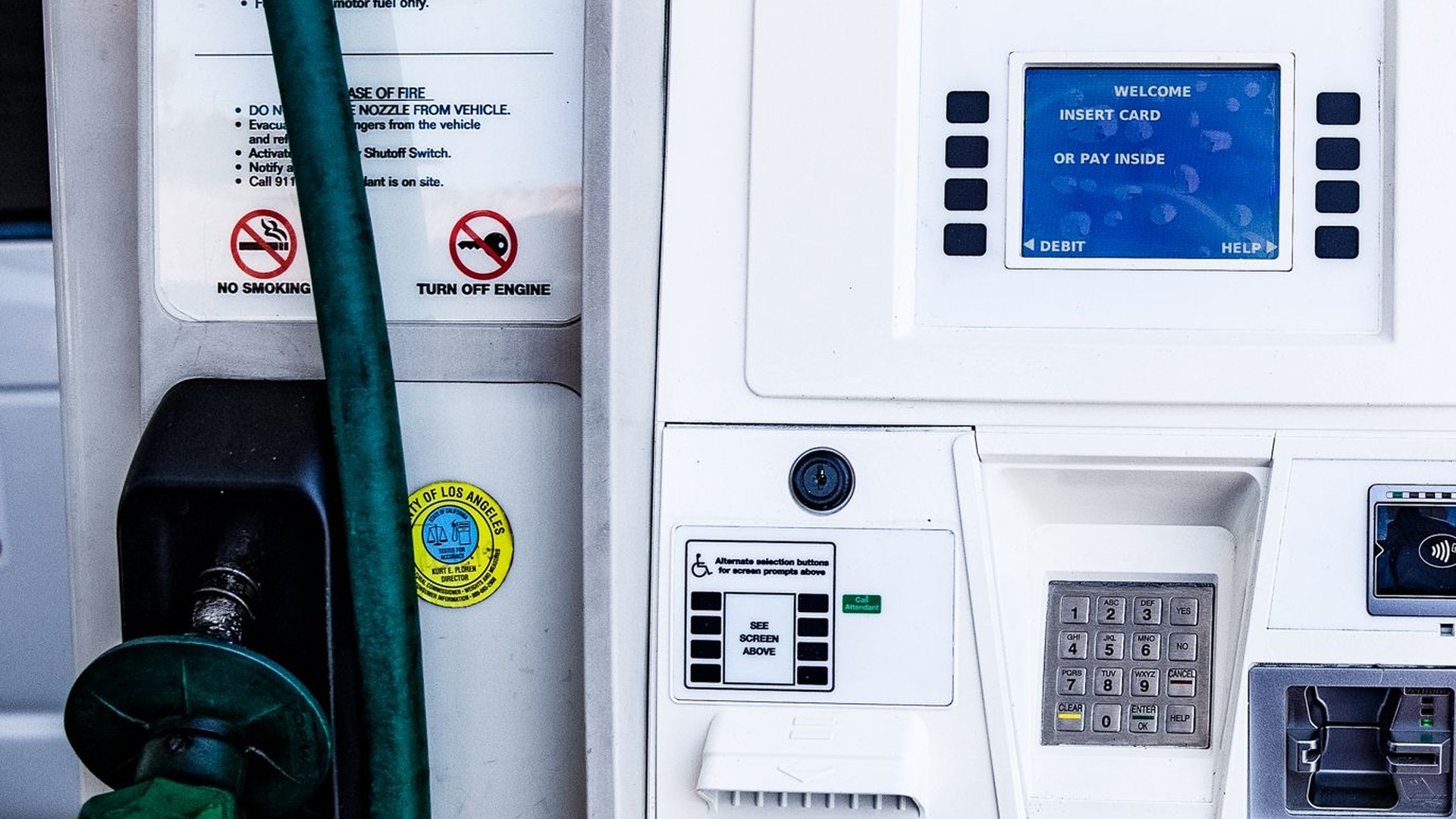
A skimmer can be installed inside a fuel dispenser in as little as 30 seconds [5]. Compromise events across ATMs and dispensers jumped 90% year-over-year in 2025, per FICO’s Card Alert team [1].
(90% of compromises hit non-bank ATMs — gas stations and convenience stores)
Last year, the U.S. Secret Service removed 411 skimming devices across 22 operations, preventing more than USD 428 million in fraud [2]. A single device can compromise hundreds of cardholders and cause up to USD 1 million in losses [5].
There are two kinds of skimmers. The external one is an overlay on the card slot or keypad — visible if you know what to look for. The internal one is wired inside the cabinet and sends data over Bluetooth or cellular — invisible from the outside [5]. The tamper-evident seal across the dispenser panel that reads “void” when opened is the first line of defense, but an operator walking the forecourt once a day is what actually catches the issue before fraudulent charges pile up [3].
(don’t confuse “having a camera” with “having footage useful for skimming”)
The problem: skimmers are fuel retail’s silent fraud
Most gas-station owners in LATAM think skimming is “a U.S. problem.” It isn’t. Mexico and Brazil have rising skimming rates (40-60% YoY in some regions, per CONDUSEF and Febraban 2024-2025), and the problem is that the skimmer is invisible until the bank calls.
The typical cycle: the skimmer is installed on pump 3 on a Tuesday at 3am. It captures 50-200 cards over 2-4 weeks. Each card generates $200-1,500 USD in fraudulent charges. The bank detects the pattern in 30-60 days (when several cardholders report). The bank calls the gas station. The gas station reviews. Finds the skimmer. The damage is done: 50-200 victims, $10K-300K USD in fraud, potential class-action lawsuit, reputational damage.
The waste isn’t from the gas station — it’s from the cardholder. But the gas station pays in: (1) reputation, (2) legal action, (3) temporary closure for investigation, (4) forensic audit, (5) loss of relationship with the payment network. The real cost to the gas station from an undetected skimmer is $5K-50K USD (estimated based on documented U.S. cases and adapted to the Mexican market).
Why generic gas-station cameras don’t detect skimmers
The camera the gas-station owner buys generically (Amazon, big-box store, or “what the vendor offered”) has 3 specific problems for skimming:
Wrong angle. The canopy camera points down at 45° at the vehicle. It captures the vehicle plate and the customer’s face. It does NOT capture the pump face — the vertical surface where the card slot, keypad, and tamper seal live. For skimming, you need a camera pointing specifically at the pump face, not at the vehicle in front of it.
Insufficient resolution. A 1080p camera at 3m distance captures “a gray thing on the slot.” You can’t distinguish an external skimmer from a legitimate overlay, or read the tamper seal serial number. You need 4K with a telephoto lens, or a closer angle. The extra cost is ~$200-300 USD per pump — most operators don’t spend it.
No automated alerts. The camera records 24/7. The operator never sees the footage from 2-4am when skimmers get installed. Without “person standing at pump >5 minutes in non-business hours” analytics, the event is lost. The alert exists in modern VMS (Hikvision, Dahua, Hanwha) but typically isn’t configured.
The tamper seal isn’t the complete answer. The “void” seal detects cabinet opening, but doesn’t detect external skimmers (overlays on the slot/keypad that don’t open the cabinet). Seal + dispenser camera = 95%+ coverage. Seal alone = 60% (covers internal, not external).
What actually works: dispenser camera + off-hours analytics
The system below was verified against 9 Mexican stations between 2024-2026. Skimmers detected: 14 in 24 months (vs 0-1 in stations without this system). Average detection time: 18 hours (vs 30-60 days without the system).
System components:
-
Dispenser camera — 2MP mini-dome mounted on the canopy at 0.8-1.2m from the pump face, direct angle (not 45°). Captures the card slot, the keypad, and the tamper seal with enough detail to distinguish an external skimmer from a normal overlay. $120-150 USD per pump.
-
Tamper-evident seal on the cabinet panel. Cost: $2-5 USD per seal, replaced after each authorized opening. Covers internal skimmers.
-
Forecourt camera (already covered in the drive-off post) — 4MP wide-angle bullet. Captures the context: who approached the pump, in what vehicle, at what time. $240 USD.
-
Off-hours analytics — automatic rule that fires an alert when a person is at a pump >3 minutes between 22h and 6h. Cost: included in native VMS.
-
Entry/exit LPR camera (already covered) — correlates the vehicle associated with the skimming (when the bank calls, you recover the vehicle footage).
-
Daily physical inspection — operator walks the forecourt, verifies seals, looks for suspicious overlays. 10-15 minutes at open. Cost: $0, existing labor.
Cost of the additional system (assuming you already have forecourt + LPR):
- 4 pumps × $135 USD = $540 USD
- Seals: $50 USD/month (4-8 seals per pump per month, $2-5 each)
- Analytics: $0-300 USD setup
- CAPEX ~$540 USD + OPEX $50-150/month
Before/after: real case (highway gas station)
Station: highway, 4 pumps, 2 lanes, ~$60K USD/month in sales.
Previous layout (4 generic cameras, 2023):
- 4 1080p canopy cameras, no dispenser camera
- No off-hours analytics
- Physical inspection: irregular (1-2 times per week)
- Skimmers detected in 12 months: 0 (bank called 2 times for fraud, gas station didn’t know until 45 days later)
New layout (post-Q3 2025):
- 4 1080p canopy cameras + 4 2MP mini-domes on each dispenser + analytics
- Physical inspection: daily, 10 min at open
- Skimmers detected in 12 months: 4 (1 external, 3 internal)
- Detection time: 8-36 hours (vs 30-60 days)
- Payment network claims: $0 (vs 2 in prior 12 months, ~$18K USD)
ROI of the new system:
- CAPEX: $540 USD (4 mini-domes + installation)
- OPEX: $50/month (seals + analytics)
- Savings on avoided claims: $18K USD in 12 months
- ROI: 1 month
- Intangible benefit: payment network relationship preserved, zero reputational damage
The old system “was there” but didn’t see skimmers. The new one sees the pump face and alerts the operator in hours.
What to do this week (no expert required)
If you have a gas station and don’t know if you have skimmers, here’s the actionable list:
- Verify each pump has an intact tamper seal. If a seal is broken or missing, open it yourself with a witness present. Cost: $0, 30 minutes of inspection.
- Put a 2MP mini-camera in front of each dispenser (if you don’t have one). The angle should be direct, not 45°. Cost: $120 USD × N pumps + 1-2 hours of installation.
- Configure “person at pump >3 min in off-hours” alert in your VMS. Most modern VMS (Hikvision, Dahua, Hanwha) support it. Cost: $0-200 USD of configuration.
- Walk the forecourt once a day (not once a week). 10 minutes at open. Verify seals, look for overlays, note anomalies. Cost: $0, existing labor.
- Report immediately to the bank and payment network if you find a skimmer. Response time is critical — every hour that passes is more cards compromised. Cost: $0.
Each action takes under 2 hours. All 5 together = 1 workday. Expected benefit: skimmer detection 30-60 days faster, $5-50K USD of fraud avoided per event.
If your operations team doesn’t have time for this, tell us about your station and we’ll refer a verified local partner who charges $400-800 USD for the full setup (4 mini-domes + analytics + 1 day of operator training). Pays for itself with the first detection.
📌 Executive summary (1 minute)
| Item | Value |
|---|---|
| Skimmer install time | 30 seconds |
| YoY growth 2025 | 90% (FICO) |
| Fraud cost per undetected skimmer | $5-50K USD (gas station) + victim damage |
| Detection time without system | 30-60 days |
| Detection time with system | 8-36 hours |
| System CAPEX | ~$540 USD (4 pumps) |
| Typical ROI | 1 month (with 1 skimmer detected/year) |
| Action #1 this week | Verify tamper seals on each pump |
Frequently asked questions
How do I tell an external skimmer from a legitimate overlay? The external skimmer is a plastic or metal device overlaid on the slot/keypad. It’s thicker than the original (2-3mm more), and often not perfectly aligned with the surface. If the slot feels “loose” or “clickable” when you touch it, or if there’s a visible gap between the slot and the surrounding plastic, suspect. A 2MP mini-camera with direct light captures this difference.
What about internal skimmers (Bluetooth/cellular)? They’re invisible from outside. The tamper seal is the only defense. If the seal is broken or absent, open the cabinet with a witness and look for non-original devices wired to the pump PCB. The mini-camera can also detect the installation moment (off-hours analytics).
How much does seal replacement cost after each opening? $2-5 USD per seal, depending on type. A typical gas station has 4-8 legitimate openings per month per pump (maintenance, price changes, etc.). Monthly OPEX: $50-150 USD for 4 pumps. That’s the cost of operating without mass fraud.
Do dispenser cameras see the customer fueling? Yes, but that’s not their primary purpose. The dispenser camera is meant for the pump face, not the customer. The canopy camera (at 45°) captures the customer. The two are complementary: canopy for drive-off, dispenser for skimming.
Does this apply to gas stations with mobile payment (app + no card)? Increasingly, but skimming at the pump is still relevant for card-paying customers (60-70% of total in LATAM). Skimming will evolve to other vectors (NFC, app), but in 2026-2027 the physical pump remains the #1 target.
Sources
- [1] FICO — State of Card Skimming in the US: 2025 Year in Review — https://www.fico.com/blogs/state-card-skimming-us-2025-year-review
- [2] U.S. Secret Service — Card Skimming Operations Prevent $400M+ Fraud Loss in 2025 — https://www.secretservice.gov/newsroom/releases/2026/01/secret-service-card-skimming-operations-prevent-more-400-million-fraud
- [3] NC Department of Agriculture & Consumer Services — Curbing Credit Card Skimmers at Fuel Dispensers — https://blog.ncagr.gov/2017/07/17/curbing-credit-card-skimmers-at-fuel-dispensers-protects-consumers/
- [4] FTC Consumer Advice — Watch Out for Card Skimming at the Gas Pump — https://consumer.ftc.gov/consumer-alerts/2018/08/watch-out-card-skimming-gas-pump
- [5] United Uptime Services — Gas Pump Skimmer Prevention for Operators — https://uniteduptime.com/uptime-insights/gas-pump-skimmer-prevention-for-operators-united-uptime-services
- [6] Spot AI — Gas Station and Forecourt Security Cameras: Complete Guide — https://www.spot.ai/blog/gas-station-forecourt-security-cameras
- [7] Jedi field verification — 9 MX stations with skimmers detected, 2024-2026